
PRELUDE
Here is an apropos article to mark the conclusion of IMTS – International Manufacturing Technology Show 2022 in Chicago, one of the largest global in-person event held since the COVID pandemic. With Chicago as the backdrop, we define our axiom “Make no little plans. Think big” as our basis for building the future of automation by looking at all aspects of the value chain.
The following white paper by Numorpho Cybernetic Systems (NUMO) is our initiative to engineer the systems necessary to meet human needs in a complex technological world. This will account for what we are embarking on – called the fifth industrial revolution (or Industry and Services 5.0) – where the needs for neuromorphic computing (very large, distributed cloud computing with intelligence) will merge with the physicality (mechanics and physics) of machines to make, manage, maintain, and empower us in ways not imagined. Our methodology will merge Strategic Intent with Design Thinking and Systems Engineering to put forth a curated novel approach to planning and defining multi-faceted products and services that are smart, functional, adaptable, and connected.
In this seminal article as a prelude of our series on Everything Connected, we have simply laid out our story to emphasize on our plan to showcase the art of the possible by using the science of engineering and new formulations using generative AI. Though it is closing time for IMTS 2022, every new beginning comes from some other beginning’s end!

The image above is a composite picture of Chicago’s skyline I created by merging its current physical andscape and reflecting what it used to look like in the 1940s.
TABLE OF CONTENTS
- Overview
- Premise
- Background
- The Case for Planning
- Accounting for Change
- The Art of the Possible coupled with the Science of Engineering
- Composable Architecture
- AI as a Catalyst
- Summary
- ChatGPT Review
- Templated Review
Life’s too short to accept the ordinary. Dare to be extraordinary, dream big and be open minded to the art of the possible. Daniel Burnham, the architect who defined Chicago after the great fire of 1871, did not think small. In fact, he dreamed big and imagined a city that far exceeded the greatness that was lost. His statement is more famous in urban planning, and it has been quoted and requoted for much of the 20th Century, especially in Chicago. Those opening words, in particular-”Make no little plans”-have provided generations of Chicago architects and planners with heavy rhetorical ammunition in efforts to win more money or support for costly pet projects. The architect who, along with John Root, planned the World’s Columbian Exposition in Chicago in 1893. Decades later, Churchill may have subscribed to a similar philosophy, but the words are Burnham’s.
Progress is building on the happened, we need the wisdom of the past to create a better tomorrow. Isaac Newton postulated that the reason why we can see far today is because we stand on the shoulder of giants. Don Henley of the Eagles in his interview by Billy Joel reiterated on the same about music by saying “We are all standing on the shoulders of somebody, and we need to know who those people are“. But as Bob Iger rightly points out “You can’t allow tradition to get in the way of innovation. There’s a need to respect the past, but it’s a mistake to revere your past.”
“If I had asked people what they wanted, they would have said faster horses.” was Henry Ford’s famous quote on his reason of disrupting the then mode for domestic ground transportation using horse carriages. In today’s world, although it is very important to put customer first and go thru the process of assessing their wants and usage, disruption requires thinking out of the box for products and services that aim to surprise and delight them, have them anticipatory, craving for the next new totally different experience.
Imagining the future requires intense planning. In today’s world we need to link and intertwine heterogeneous systems, make them interoperable, aggregate data and provide pertinent information at the right time and the right place with flexibility and ease of use. Systems like Cloud Computing, Big Data and Analytics, AI and ML, Digital Thread and Digital Twin, and AR/VR/XR are already being used in all new architectures, and technologies like Distributed Ledger using Blockchain are showing a lot of promise.
For large scale planning and defining new ecosystems, it is necessary to understand modernistic approaches to design. We also need to account for the knowns and the unknowns, ask the right questions and define the strategic case and intent. A well-defined framework for managing complexity and change is essential. This is the key to planning and engineering systems for Industry 4.0, a construct that merges software and hardware, digital and physical, intelligence and mechanics. Here, flexibility, scalability, security, and speed will be prime considerations.
Future-proofing designs for such endeavors entails creating dynamic blueprints that move beyond current 2D and simplistic 3D animations, to constructs that morph – dynamically change, evolve, and articulate with the conditions and the environment, and are embedded with intelligence that will learn, consider, and evolve. This article will set the stage for such transformational recipes using Parametric Modeling, Generative Design, Digital Twins, AR//VR/XR, Agentic constructs and other technological artifacts to render these artifacts in an immersive environment.
With the advent of Artificial Intelligence and its integration into various industries, the possibilities for designing dynamic, intelligent, and adaptable systems have never been greater. The integration of generative AI to process engineering paves the way for unprecedented innovation and transformation. As we embrace this powerful technology, we must also ensure that ethical considerations are upheld, such as ensuring data privacy and promoting transparency in algorithmic decision-making. By doing so, we can harness the potential of generative AI to engineer dynamic, intelligent, and future-proof systems that not only meet the demands of Industry 4.0 but also contribute to a sustainable and prosperous future for all.
“Make No Little Plans” is a quote by Daniel Burnham who practiced intense minimalism. The image below is on Cortland avenue with the backdrop of drawings of the skyscrapers of Chicago.

Here is his entire treatise on Thinking Big:
“Make no little plans. They have no magic to stir men’s blood and probably themselves will not be realized. Make big plans; aim high in hope and work, remembering that a noble, logical diagram once recorded will never die, but long after we are gone will be a living thing, asserting itself with ever-growing insistency. Remember that our sons and grandsons are going to do things that would stagger us. Let your watchword be order and your beacon beauty. Think big.”
— Daniel Burnham, Chicago architect (1864-1912)
Today as we look to upgrade our technical progress by a magnitude, this phrase and the entire treatise are a testament to the spirit of humankind of simulating nature in achieving order and beauty in all our creations. The Bauhaus Methodology and the MAYA (Most Advanced Yet Applicable) Design Concept are further testament to the guiding principles in design where form not only follows function but also accounts for manufacturability, sustainability, beauty, and purposefulness in all aspects of the progression of the build, its production, commercialization, service, and support. We should also be mindful of customer feedback and these insights need to be curated to affect the next variant of the product and service or bring to being entirely new assemblages that would excite and delight the customer and amplify their existence.
Architecture in the traditional sense is understood mainly as designing and building static structures like houses and buildings. This concept of planning and constructing three dimensional artifacts starts with creating 2D blueprints and elevating it up to 3D is limited to form and function. The intended function determines the structure – this has become more prominent as in the Pattern Language preached by Christopher Alexander followed by the modernistic approaches in the Bauhaus and MAYA designs.
Frank Lloyd Wright prescribed a philosophy called Organic Architecture which follows a belief that the natural life that exists in a space should flow into, peacefully coexist with and benefit from whatever is constructed there. He believed architecture was “the mother of all arts” and could transform the world. Over the seven decades of his long career, he created some of the most innovative buildings of the 20th century. He was a visionary figure whose ideas were often so radical and ambitious that they seemed impractical, even dangerous. Wright always insisted architects should not confine themselves to merely designing pretty buildings. He left a legacy of buildings second to none in American architectural history. When asked by a prospective client which of all his creations would he consider to be his best and favorite, he would always answer: “Yours.”
But advances in building materials and digital design technology have gradually caused the field of architecture to move beyond Wrights shadow. The skyline of Chicago is testament to this, where building construction still continues unabated to define and redefine the extant of the lake view and the river front. Chicago has been defined as the city that changed skyscrapers forever, its buildings and architecture have reflected the history of American Architecture from brick to stone to steel to tube in frame to glass to emphasize and restate their vertical nature. These structures not only required new ways of planning, designing, and engineering but also costing, people and equipment management, materials procurement, analysis, and future serviceability to completely understand all the ramifications of a new way of doing things.
SECTION 4: THE CASE FOR PLANNING
In business unlike life, there are no accidents. This section will be the basis to be structured and detailed, to follow first principles, the master plan, the charter, the manifesto, the rudiments of the blueprint, and architecting the solution of form following function, and utilizing smart manufacturing, and all the strategies entailed.
The theme is to create a nimble and flexible ecosystem that steps thru:
- Upstream Systems – research, ideation, and product development
- Midstream Systems – smart manufacturing, logistics and supply chain
- Downstream Systems – marketing, sales, support, and service
- Backoffice Systems – ERP, Order Management, Procurement, Inventory Management and Financials
utilizing Process Management Tools and concepts in Operations Research and planning like; Linear Programming, CPM, PERT and Monte Carlo Simulations. All of the above systems will need to be integrated and coordinated for all aspects of the Product Lifecycle Management (PLM) and other needs that are required for efficient and optimal functioning of the enterprise.
SECTION 5: ACCOUNTING FOR CHANGE
Quoting Heraclitus, James Chambers the former Chairman and CEO of Cisco said “The only constant is change,” in putting forward the future plans for the company “the Internet will change the way we work, live, learn, and play.” But change is hard. In The Phoenix Encounter Method, the authors postulate that all businesses sooner or later face the need to reconstruct their future. Businesses must innovate, or they will die. They will need to destroy part or all of the incumbent business models in order to build their breakthrough, future ready organization. “One has to die first to be reborn!”
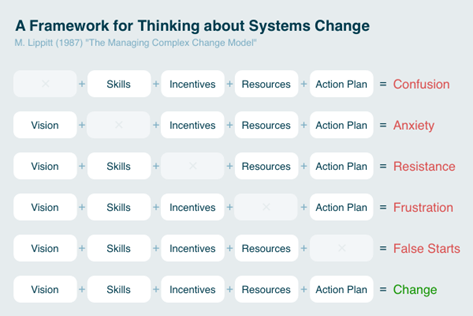
The diagram above discusses the framework for thinking about systems change based on five different criteria:
- Confusion → lack of Vision: note that this can be a proper lack of vision, or the lack of understanding of that vision, often due to poor communication and synchronization of the people involved.
- Anxiety → lack of Skills: this means that the people involved need to have the ability to do the transformation itself and even more importantly to be skilled enough to thrive once the transformation is completed.
- Resistance → lack of Incentives: incentives are important as people tend to have a big inertia to change, not just for fear generated by the unknown, but also because changing takes energy and as such there needs to be a way to offset that effort.
- Frustration → lack of Resources: sometimes change requires very little in terms of practical resources, but a lot in terms of time of the individuals involved (i.e. to learn a new way to do things), lacking resources will make progress very slow and it’s very frustrating to see that everything is aligned and ready, but doesn’t progress.
- False Starts → lack of Action Plan: action plans don’t have to be too complicated, as small transformative changes can be done with little structure, yet, structure has to be there. For example, it’s very useful to have one person to lead the charge, and everyone else agreeing they are the right person to make things happen.
SECTION 6: THE ART OF THE POSSIBLE COUPLED WITH THE SCIENCE OF ENGINEERING
Design is not the product of a linear mechanical process but emerges from a process of mutual co-adaptation brought about by concepts like Design Thinking. It proceeds in evolutionary cycles, with the information on successes transmitted in a DNA-like message confirming and reaffirming the different attributes of the solution looking at it from outside in. Natural systems work just this way (reactive) to solve problems and achieve sustainability: specifically, they retain and evolve information about adaptive form.
This idea stands in stark contrast to the conventional model of design technology – Systems Engineering, bottom-up methodology – which is based upon the mechanical assembly of forms to achieve visual novelty. In that model, quantitative criteria are specified and assessed ahead of time, and a design is engineered to meet those defined program criteria. This program is organized around a rationalized “template” whose elements are segregated and standardized to achieve economies of scale.
Patterns exist within and influence many aspects of design and technology. A Pattern Language by Christopher Alexander is a compendium of 253 “patterns” that cover elements of environmental design, spanning the scale, from regional planning down to construction details. This book triggered a surprising explosion in software technology and spawned a new class of software called “design patterns”. That software now helps to power Macs, iPhones, most games, and many other computer systems. Many other fields have begun using pattern language technology successfully, including molecular biology, economics, product engineering, organizational management, and service design, to name a few. It is important to understand that patterns don’t replace the design process with an automated solution. The designs don’t just “pop out.” Rather, the patterns incorporate the information about previously successful solutions, in a way that designers, working adaptively and in a human scale, have more ready access to it. In this sense, the patterns are a tool for a very important concept known as “evidence-based design” — design that is well-adapted to solve human problems and demonstrated to meet human needs.
In our case it is about merging design thinking – the art of the possible, with systems engineering – the strong basis of functionality using science and math to compose future architectures that are not only resilient and sustainable, but also inspire the current and generations to come to make dreams a reality.
SECTION 7: COMPOSABLE ARCHITECTURE
Without going into the details of the technology (this will be articulated in later documents where we will add modularity and agentic constructs to our platform underpinnings), the following are the needs for a composable framework in the new paradigm:
- multiple cloud ecosystems will need to talk to each other,
- the Service Level Agreements (SLAs) need to be properly understood,
- their heterogeneous integrations (interoperability) will need to be defined and
- a People, Process, Platform (PPP) governance model needs to be set up and planned for the operating model of the business.
Change Management also needs to be accounted for and in this fast-paced era of changing systems: Technical Debt.
We need to go beyond Gartner’s Pace Model to define such interactions. In a prior article for a Hyperconnected Ecosystem, I had defined the following interaction model for a planned staging of the different needed components, as shown alongside, where the horizontal capabilities intersect with the vertical domains to plan for a precise working mechanism for future ecosystems.

AI serves as a catalyst to propel our mantra of “Make No Little Plans” to new heights. As we navigate through the complexities of the post-2020 world, AI’s unparalleled ability to process and learn from vast amounts of data enables us to create more accurate predictions and informed decisions. This equips us with the foresight necessary to design innovative, resilient systems that are not only adaptable to the changing needs of customers but also capable of anticipating future trends and demands.
Furthermore, AI’s integration into our Digital Twine blueprint process amplifies the efficiency and intelligence of our processes, driving innovation and productivity at every stage. By incorporating AI and machine learning into the product lifecycle, we can identify patterns, optimize resources, and deliver smart, personalized solutions that enrich the customer experience.
AI is the game-changer that empowers us to “Go Big” while staying true to our vision of creating a sustainable, prosperous future. With AI as a key driving force, NUMO is poised to lead the way in building a brighter tomorrow where innovation and technology converge to push the boundaries of what is possible.
We use AI/ML driven by Physmatics (a mélange of Physics and Mathematics) to appropriately drive and manage processes intelligently and efficiently via our Digital Twine World Model (DTWM) blueprint process. We will provide the basis for the Art of the Possible using science of engineering by incorporating new technology, material composites, parametric and generative design techniques combined with a collaborative and agile methodology for doing. It will draw on natural sciences, intellectual history and 21st century technology to identify environments conductive to innovation by facilitating brainstorming of solutions. We will build a connected synthetic ecosystem of people, processes and platforms that enables collaboration, co-creation, and ideation. Thus, the process to make, manage, move, market, and maintain will be themed and pragmatic to build smart and connected solutions of the future.
The use of Generative AI in the field of process engineering, especially within the context of our theme, can revolutionize the way we approach planning and constructing future-proof ecosystems.
- Generative AI offers immense potential for generating, iterating, and refining complex designs based on specified parameters and data analysis. By utilizing this technology, process engineers can leverage vast amounts of data to create optimized, adaptable, and responsive systems. This aligns perfectly with the ideals of Industry 4.0, which emphasizes the convergence of digital and physical realms.
- Generative AI can be employed in conjunction with other cutting-edge technologies like AR/VR/XR to enhance the visualization and manipulation of evolving designs. This symbiotic relationship enables engineers to analyze and refine processes in immersive, real-time environments, ensuring adaptability and resilience in the face of dynamic change.
- Additionally, generative AI can assist in addressing the complexities and unknowns inherent in large-scale planning by learning from historical data, identifying patterns, and making predictions to guide decision-making. Embedding this intelligence within the design framework allows the blueprint to continuously evolve and adapt to changing conditions and requirements, further future-proofing the system.
The events of 2020 and the COVID pandemic debacle taught us that we weren’t prepared and caught the world off guard. Now, we have to re-think a lot of our processes – how we interact, how we communicate and how we live. It has in no small measure changed the footprint of our step in our progress as a civilization. It has defined new knowns and created more unknowns. It has made the case for good and thorough planning ever so pertinent.
We may also learn as we go along this journey that the “big is not always beautiful.” Talents and beauty need to be widely distributed and scattered around as much as they need to be in concentrated nodes. NUMO’s products will further flatten the world to make it more connected with the redistribution of talents and beauty in this vast space of the earth and in the Universe.
Re-imagining the future in this new paradigm requires looking beyond artifact creation and invention, to engineering systems that are nimble, flexible and adaptable to the changing needs of the customer and the world. They should keep in step with the progression of technology, our new understanding of the universe we live in and our self-introspection of who we are. It should also account for all our inalienable rights, be mindful of our place in history, of our position amongst the living and the particles that constitute our being.
Delivering innovation for us at Numorpho Cybernetic Systems (NUMO) is not just about checking the box for Product Development but also following thru the entire lifecycle of the product – up-stream, mid-stream and down-stream to connect all the dots between the different systems and 3rd party services. This enables Design for Manufacturability considerations, appropriate procurement and supply-chain logistics, financial planning, and customer enablement via themed marketing, sell and support.
“Make No Little Plans” will be the go forward mantra for our company as we define the strategy, design its constituents and progress on our exacting journey to build that very set of compelling products and services, which will make a difference in the tomorrow as we sustain our planet and explore the stars.
Go big or go Home is our addendum to Daniel Burnham’s famous quote.
NITIN UCHIL – Founder, CEO & Technical Evangelist
nitin.uchil@numorpho.com
SECTION 10: Summary by ChatGPT
NUMO encourages embracing extraordinary endeavors and thinking expansively, drawing on the visionary approach of figures like Daniel Burnham and Henry Ford who challenged the status quo. NUMO emphasizes the importance of learning from the past and innovating beyond traditional expectations, resonating with the insights of Isaac Newton and Bob Iger. This chapter introduces the concept of envisioning a technologically advanced future, blending various cutting-edge systems and technologies to enhance human capabilities and experiences.
To effectively plan and establish new ecosystems on a large scale, understanding modern design approaches like the Bauhaus Methodology and MAYA (Most Advanced Yet Applicable Concept) is crucial. Accommodating both known and unknown factors, formulating strategic objectives, and implementing a well-defined framework for managing complexity and change are fundamental for engineering systems aligning with Industry 4.0, which integrates software and hardware, digital and physical elements, and intelligence and mechanics, prioritizing flexibility, scalability, security, and speed. Future-proofing designs for such endeavors involves evolving beyond 2D and simplistic 3D animations, creating dynamic blueprints that adapt and articulate with changing conditions and environments, embedding intelligence for learning and evolution. This article lays the groundwork for this transformation, exploring the use of AR, VR, XR, and other technological tools to render immersive, adaptive artifacts in a dynamic environment.
This treatise showcases the human endeavor to mimic nature, embracing design principles from Bauhaus Methodology and MAYA Design Concept, emphasizing form aligned with function, manufacturability, sustainability, beauty, and purposefulness. Gathering and integrating customer feedback is pivotal, guiding the evolution of products and services to excite and enhance customer experiences. As architecture evolves beyond traditional static structures, influenced by Organic Architecture and digital advancements, it demands innovative approaches to planning, design, engineering, cost estimation, and future serviceability, redefining the modern architectural landscape.
In business, randomness doesn’t exist—everything is meticulously structured based on first principles, encompassing a master plan, charter, manifesto, blueprint essentials, and a design solution that prioritizes function over form and leverages smart manufacturing. NUMO’s objective is to craft an agile and adaptable ecosystem with a structured flow across upstream, midstream, downstream, and back office systems, integrating tools like Linear Programming, CPM, PERT, and Monte Carlo Simulations for efficient Product Lifecycle Management (PLM) and operational optimization within the enterprise. This framework ensures seamless coordination and integration of all components, optimizing the enterprise’s functionality and effectiveness.
Former Cisco Chairman and CEO, James Chambers, quoted Heraclitus, emphasizing that change is the only constant and the internet’s transformative impact on work, life, learning, and play. The Phoenix Encounter Method underscores that businesses must innovate and reconstruct their future to survive, necessitating the destruction of existing business models to create a future-ready organization. The provided framework illustrates how addressing vision, skills, incentives, resources, and action plans is crucial for successful systems change within a business, guiding the transformation process effectively.
Design is a dynamic, non-linear process shaped by mutual co-adaptation, notably driven by concepts like Design Thinking, fostering an evolutionary cycle that integrates information from successful iterations. This contrasts sharply with the conventional Systems Engineering approach, which emphasizes mechanical assembly of predefined forms and quantitative criteria, guided by standardized templates for efficiency. Recognizing and applying patterns, as illustrated by Christopher Alexander’s Pattern Language, is crucial in various fields, allowing designers to access successful solutions and incorporate adaptability and human-centered problem-solving into the design process, ultimately aiming to create resilient, sustainable, and inspiring future architectures.
In summary, the emerging paradigm necessitates a composable framework to address crucial aspects: seamless communication between diverse cloud ecosystems, understanding and meeting SLAs, defining integrations for heterogeneous systems, and implementing a robust People, Process, Platform (PPP) governance model for effective business operations. The transformative events of 2020, including the COVID pandemic, emphasize the imperative for thorough planning and adaptation, encouraging a reevaluation of processes and interactions in our rapidly changing world. NUMO envisions innovation not only in product development but throughout the product lifecycle, utilizing AI/ML and Physmatics to intelligently manage processes and create smart, connected solutions.
SECTION 11: TEMPLATED REVIEWS (PERPLEXITY)
TAKE 1 (No Research)