
“Reports that say that something hasn’t happened are always interesting to me, because as we know, there are known knowns; there are things we know we know. We also know there are known unknowns; that is to say we know there are some things we do not know.”
– Donald Rumsfeld
PROLOGUE
In this article of our series on Everything Connected we discuss our Cybernetic Framework for managing complexity so that processes can be optimized and harmonized across all touch points in the realm of the new industrial revolution.
BACKGROUND
There are things known and things unknown and in between are the doors – Jim Morrison
In building the new, innovating and effecting disruption, there are known-knowns, known-unknowns, unknown-knowns, and unknown-unknowns, all of which need to be managed to chart a path forward. In the engineering of systems, it is all about capturing the knowns and accounting for the unknowns as we progress in the journey of building the constituents of tomorrow.
Managing Complexity is about the understanding of knowns and unknowns to effectively organize and orchestrate process-based systems. We will utilize the Johari window shown above to depict complexity and how data and information would be managed to account for its variations as we move thru the different combinations to arrive at pragmatic solutions.
The Knowns and Unknowns categorization has been used since the Greek era and in many areas of knowledge. It is a powerful tool to surface what we know and don’t know about a problem. The knowns and the unknowns have to be treated in very different ways. We need to adapt our methods to the type of knowledge (including our lack of knowledge, which is also knowledge, if we are aware of it).
THE JOHARI WINDOW
In the 1950s two psychologists, Joseph Luft and Harrington Ingham, developed the Johari Window, a method to help people evaluate what they think about themselves in contrast with what others think of them. The Johari framework can help us to understand our approach to knowledge, to research and to solutioning:
- What do we know already (known knowns)?
- What about biases and unconscious decisions (unknown knowns)?
- Are we aware of our assumptions (known unknowns)?
- Are we conscious of what we are not exploring (unknown unknowns)?
The Johari window is a tool used in psychology to help individuals better understand their own self-awareness and the awareness that others have of them. It is represented by a four-quadrant grid, with each quadrant representing a different type of knowledge or information.
- The first quadrant, “open self,” represents information that is known by both the individual and others.
- The second quadrant, “hidden self,” represents information that is known by the individual but not by others.
- The third quadrant, “blind self,” represents information that is known by others but not by the individual.
- And the fourth quadrant, “unknown self,” represents information that is not known by either the individual or others.
In the context of managing complexity, the Johari window can be used to identify and understand the different types of knowledge and information that need to be managed in order to effectively organize and orchestrate process-based systems. This can help to identify and address any gaps in knowledge or understanding, and ensure that all necessary information is available to support decision-making and problem-solving.
MANAGING COMPLEXITY
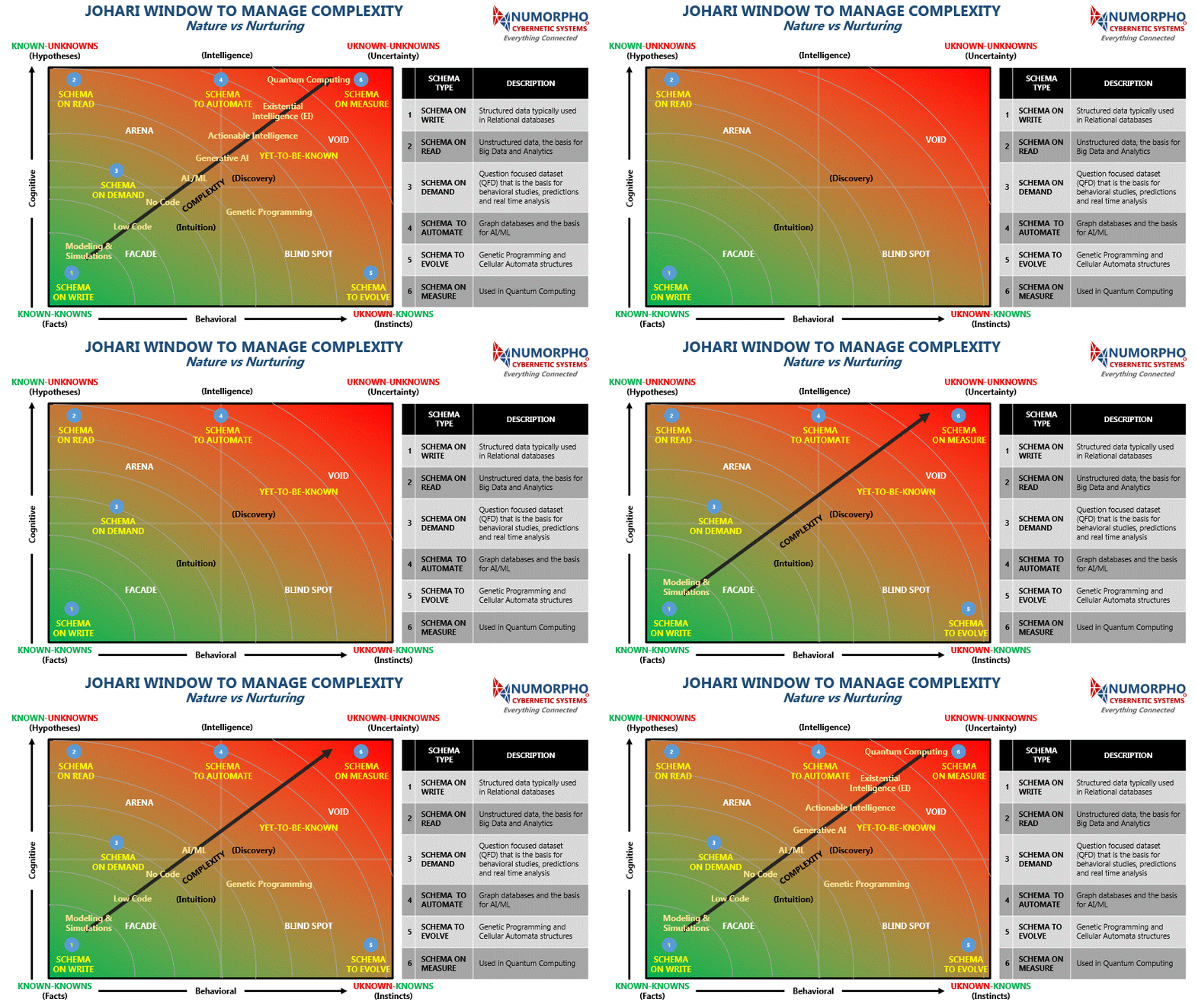
As depicted in the diagram above, we have highlighted the four quadrants of the Johari window that helped us define the concepts (knowns and unknowns) associated with each of the quadrants. Herewith we dissect each quadrant of the Johari window to have a basis for analyzing complexity:
- Known- Knowns (Facts): The first step to solutioning is knowing what you have. You use analytics data to check those facts against them.
- Known-Unknowns (Hypotheses): Knowing what you don’t have is important so that you can embark on a journey to find it. You build a hypothesis that can be confirmed or rejected with measurements.
- Unknown-Knowns (Instinct/Intuition): These are governed by evolutionary considerations and can be put aside if we trust the data instead.
- Unknown-Unknowns (Uncertainty): In quantum theory for example, the process of measuring changes the outcome.
For Known-Knowns and Known-Unknowns inductive logic is used for reasoning, whereas for Unknown-Knowns and Unknown-Unknowns exploratory techniques are more suitable.
Utilizing this, we have built a comprehensive cybernetic framework:
- to manage data – its ingestion, its normalization, its storage, its analysis and its rendering,
- process knowledge, and
- create the basis for actionable intelligence
by constructing a multi-modal schema to store the different types of information. This then lends nicely to the different constructs of analysis starting with High Code (Modeling and Simulations) to progress to Low Code, No Code, GPT based NLP, AI/ML, Generative Intelligence using genetic programming, Existential Intelligence (our new construct for actionable intelligence) and finally Quantum Computing.
This cybernetic framework will be the basis of our fourth tenet – the TAU Codex Orchestrator to enable actionable intelligence by enabling a multi-modal basis of trained neural networks.
UNDERSTANDING EMERGING TECHNOLOGIES

In a parallel article, emerging technologies that form the underpinnings for this change are discussed. Code named DARQ – it defined and detailed Distributed Ledger, Artificial Intelligence, the different types of Realities – virtual, augmented, extended and hybrid, and Quantum Computing – all of which will form the essential ingredients for defining the future.
For large scale planning and defining new ecosystems, it is necessary to understand all the forces that are needed to effect the change. We also need to account for the knowns and the unknowns, ask the right questions and define the strategic case and intent.
A well-defined framework for managing complexity and change is essential. This is the key to planning and engineering systems for Industry 4.0 and more importantly in Industry and Services 5.0, constructs that merges software and hardware, digital and physical, intelligence and mechanics. Here, flexibility, scalability, security, and speed will be prime considerations to future-proof new solutions.
Based on the above construct, we had devised a framework for cybernetics that would enable the processing of information in its different variations. This tapestry would be essential as we navigate the theories of new science to make them actionable and practical for use as we progress on our journey. We will also elaborate on expanding cybernetics to the fifth order to account for our new understandings and enable our progression to a more holistic view of cause and effect.
SOLUTIONING
Solutioning is a progression on “knowing”. In this context, depicted above, we have modified the theme of a Johari window (as detailed above) to explain how complexity can be managed/understood by bucketing them into different information schemas. It starts with the premise of “known knowns” and progresses to the level of “unknown unknowns” to elaborate where six different schemas fit in the complexity scale that spans diagonally across the 2×2 matrix. These schemas have been previously defined in a paper on a Tapestry for Computational Cybernetics that laid a framework for mind-machine interactions. Cybernetics is a wide-ranging field concerned with regulatory and purposive systems.
A new transitional phase of knowledge “yet to be known” is introduced which may aptly apply to hypotheses, theories, etc. that are widely accepted by respective professions as reality based, pointing to a known unknown that may be just around the corner to be proven to be true (like the Unified Filed theory in Physics). This is particularly applicable in the field of medicine when pharmaceutical companies conduct clinical trials to validate the efficacy of their drug formulations. This “yet to be known” concept would lie in the center of the Johari window and provide for the metamorphosis of information from the unknown state to the known.
SUMMARY
As we progress beyond ideation which is primarily driven by Story Telling and Design Thinking to building the basis for products and services driven by Systems Engineering, we need to be cognizant of what we know.
The events of 2020 and the COVID pandemic debacle taught us that we weren’t prepared and caught the world off guard. Now, we have to re-think a lot of our processes – how we interact, how we communicate and how we live. It has in no small measure changed the footprint of our step in our progress as a civilization. It has defined new knowns and created more unknowns. It has made the case for good and thorough planning ever so pertinent.
Re-imagining the future in this new paradigm requires looking beyond artifact creation and invention, to engineering systems that are nimble, flexible, and adaptable to the changing needs of the customer and the world. They should keep in step with the progression of technology, our new understanding of the universe we live in and our self-introspection of who we are. It should also account for all our inalienable rights, be mindful of our place in history, of our position amongst the living and the particles that constitute our being.
We, at Numorpho Cybernetic Systems (NUMO) believe that managing complexity by assessing the knowns and unknowns as we build smart products using intelligent mechanisms is the basis for asserting the viability and long-term sustainability of our solutions. This would provide the basis for analyzing risk and accounting for uncertainty in the process of solutioning.
End quote by Socrates:
- One who knows and knows that he knows… his horse of wisdom will reach the skies.
- One who knows but doesn’t know that he knows… he is fast asleep, so you should wake him up!
- One who doesn’t know but knows that he doesn’t know… his limping mule will eventually get him home.
- One who doesn’t know and doesn’t know that he doesn’t know… he will be eternally lost in his hopeless oblivion!
NITIN UCHIL Founder, CEO & Technical Evangelist
nitin.uchil@numorpho.com