
“What kind of world do you want? Think anything. Let’s start at the start, build a masterpiece. But be careful what you wish for. History starts now” – Five for Fighting
PROLOGUE
Outside-Inside is our basis for harmonizing information flow within our business and relating it with external 3rd party services that we will correspond to. This to ensure that all information is relevant, timely and accurate throughout the organization. The following general areas are addressed by this process:
- Data Accuracy – Checks are made to ensure that the data that is being inputted into the system is accurate.
- Data Completeness – Checks are made to ensure that all required data is being inputted into the system.
- Data Consistency – Checks are made to ensure that the data being inputted into the system is consistent with other data within the system.
- Data Timeliness – Checks are made to ensure that the data being inputted into the system is timely.
In this article, we get a bit more technical than our prior posts. “Without” when used in conjunction with within means outside. In this article we summarize our integration protocol from an outside-inside perspective to build robust ecosystems based on composable architectures.
OVERVIEW
A business comes into being thru interactions – with external influences like customers, partners, and suppliers, and with internal units and the team to provide a holistic view of its existence. Just like in Physics where atoms are composed of constituent particles, or in the philosophy of Gestalt where the whole is greater than the sum of its parts, so too with enterprises – the units that aggregate must function effectively within and in relation to the others so that their interactions can completely help the functioning of the enterprise.
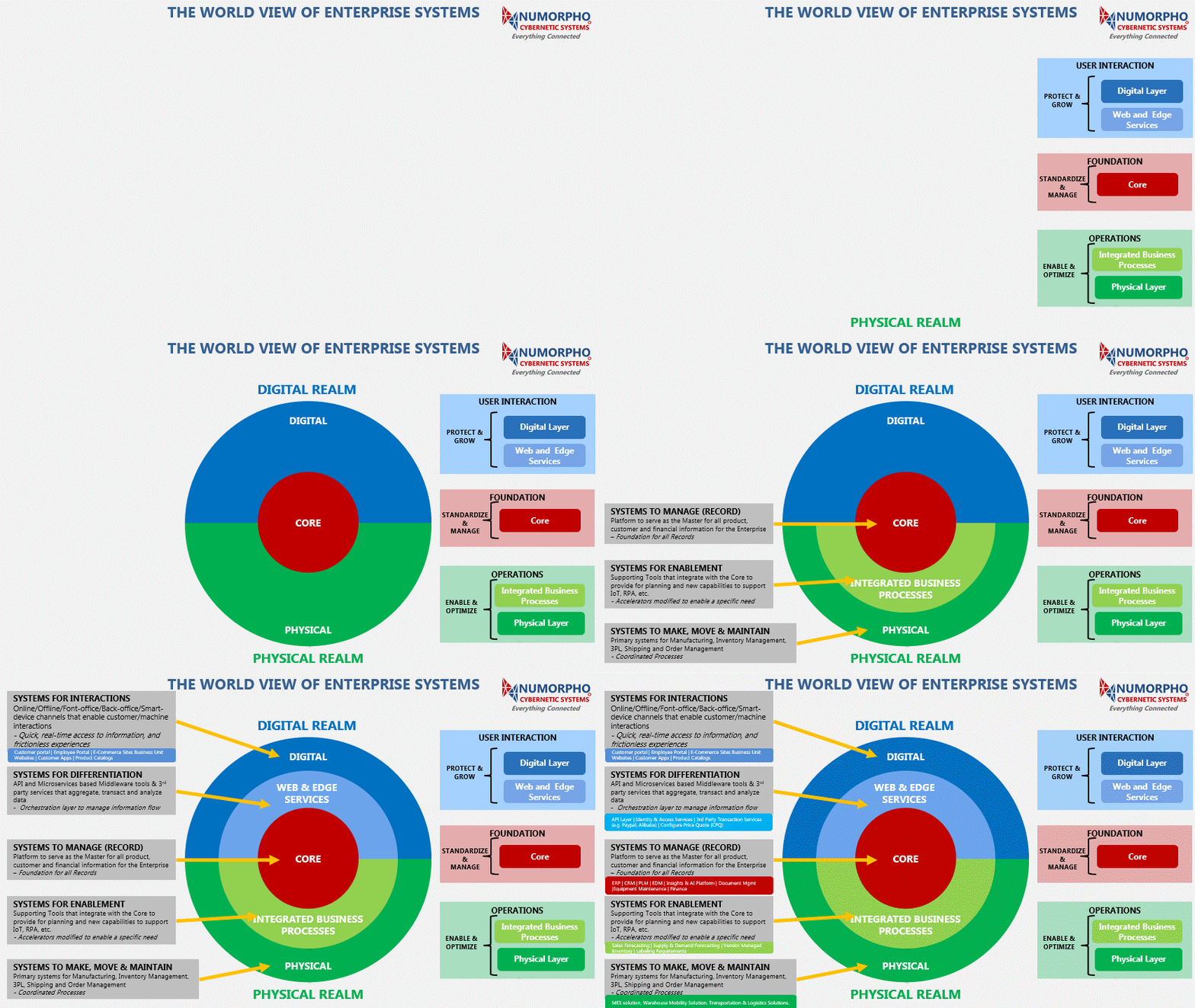
The dynamic diagram above represents the current constituents of a typical enterprise comprising of the physical realm (where products are made) and the digital realm (where virtual manifestations enable ideation, prototyping, virtual manufacturing, go-to market analysis, and customer enablement.
ENABLERS, ENHANCERS AND EFFECTS
According to a recent whitepaper developed by International Organization for Standardization (ISO), we are at a stage within Industry 4.0 where some of the new disruptive technologies are mature enough to be leveraged by the industry (referred to as “Enablers”). As part of this journey, there are also a set of design principles that are currently under development and of high relevance for archiving successful implementation of smart manufacturing (referred to as “Enhancers”). The three characteristics that allowed technologies to become enablers are:
- Cheap and abundant data storage
- Fast and responsive computers and calculation power
- Ubiquitous and place-independent connectivity
Cheap, fast and reliable data are the basis for today’s accelerated digital transformation. Enablers that have come about from this rapid development include:
- additive or 3D technologies,
- sensor and measurement technologies,
- internet of things,
- virtual and augmented reality,
- industrial and collaborative robotics,
- simulation,
- Artificial Intelligence,
- wireless connectivity,
- cloud computing,
- industrial (cyber) security,
- blockchain,
- big data analytics.
Together these Enablers serve the basis for today’s accelerated digital transformation. When the “Enablers” are fully utilized along with the “Enhancers” there will bound to be new disruptive scenarios as we collectively transition into a “Smart Industry”. The future effects will lead to:
- Circular Manufacturing: the possibility to make products and production more sustainable and take advantage of retired products and their collected lifecycle information, filter out the essence, and use feedback for improving the manufacturing processes as well as the product itself.
- Model-based Product and Production: the ability to utilize models at every point in the product lifecycle for the optimum use of the product.
- Fully Automated Factories: the ability to use new technologies to enable new configurations of production automated to a very high degree.
- Product Customization and Personalization: the possibility to make mass-produced products more personalized
- Predictive Maintenance: the possibility to act prior to an unfavorable event (e.g. failure) and use in-process monitoring to enable the identification of the optimum time to replace parts, and hence maximize the service life.
- Edge Computing: the possibility to have all automation, including real-time control, in the edge of the cloud.
- Servitization: the possibility to augment traditional physical products with related services. Hence, the product becomes a by-product to the service.
- Data-Driven Business Models: business models that are developed and customized based on data from the business. The more data, the better the business model.
SYSTEMS OF ENGAGEMENTS TO DATA DRIVEN ARCHITECTURES
Since 2011 when the concept of System of Engagement (SOE) was brought to life we have been facing a dramatically evolution of our systems architectures. The system of engagements appeared to provide a channel of collaborative business in real time scenarios at new scales of cost and speed. This new technology trend emerged putting the traditional systems of records (SOR) at the back of our systems maps constraining the competitive differentiation for the organizations.
However, this continuous evolution has highlighted the journey as the key disruptor and how we adopt this new paradigm of the systems architectures. This journey will not be only around the early adoption of any new system of engagement and/or variants but the role of the data in the final design. We will not be more layering our landscapes on systems of records and systems of engagement but peeling the onion from data and analytical to high specialized SOX systems.
More than ever the single view of the data, their governance and real time access across the landscapes will make any systems landscape a DATA DRIVEN architecture. A data driven architecture open for integration and ecosystems collaborations.
One of the ways to reduce complexity is to provide for integration so that people, processes, and systems can seamlessly interact real time. The rise of digital services—built on a foundation of APIs, virtualization, and cloud—is enabling this and changing the way organizations view applications and the way they handle enterprise IT. To affect the kind of change that will allow organizations to compete in a truly disruptive business environment, themes like Composable Architecture and the Application Network, are being put forth to enable themed process management that are scalable, flexible, and secure.
APIs must be reusable and modular, and it goes without saying that nonfunctional requirements like compliance and security must be bulletproof. All of these requirements depend upon a lightweight, Web-centric architecture. Implement lightweight, web-centric architectures, and the design principles of API-led connectivity. A good example of this is the mandate created by Jeff Bezos in the formative years of Amazon. Called the Amazon Manifesto for Externalization, it’s tenets laid out the foundation for Amazon and AWS and is still regarded as the gold standard in the API/microservices space, as it formed the basis for much of the modern API design paradigm within the corporate view.
OUR PERSPECTIVE
The foot bone is connected to the leg bone. The leg bone is connected to the knee bone. The knee bone is connected to the thigh bone…..Doing the Skeleton Dance
In a prior whitepaper on Hyperconnected Ecosystem, we had described the basis for this composable architecture expanding on Gartner’s Pace-layered application strategy framework and MuleSoft’s three-layered architecture comprising of System, Process and Experience, to a fully connected modern Ecosystem. At Numorpho Cybernetic Systems (NUMO), we define composable architecture as depicted in the diagram below:

- Systems of Record – Provides the basis for master product and customer information, and manages people, process, and finances.
- Systems of Operations – Coordinates planning, scheduling, production, and logistics
- Systems of Enablement – Also called Middleware, it creates the bind between the master records and the front-end channels to enable digital product information and assets to be authored and managed
- Systems of Experience – Provides customers with the right information at the right time combined with personalized content based on preferences, prior history, and industry trends.
These would be augmented by the following
- Systems of Intelligence – Provide the tools to enable AI, ML and Predictive Analytics by tapping into data lakes and operational data stores.
- Systems of Engagement – Provide effective communication for marketing, sales, service, and support.
- Systems of Innovation – Provide the right collaborative framework to build next generation products, systems, and services.
- Systems of Differentiation – Provide unique value add services that enable the enterprise to differentiate from the competitors.
Thus, the Ecosystem composition is an aggregation of multiple tools, vendor platforms, on-premises and in the cloud, different operating systems, multi-channel interactions and diverse persona journeys:
- Systems of Record, Operations, Enablement and Experience enable information to cascade from business and operations to customer interactions and experience.
- Systems of Intelligence, Engagement, Innovation and Differentiation provide the capability of data analysis, intelligent prediction, the basis for new product development and a go-to-market ability for disruption and differentiation.
THE TENDRIL CONNECTOR PROTOCOL
The way we propose doing this is with API-led connectivity using a framework we call Tendril Connector. Herewith, we will define a new way of integration and communication which will follow the tenets of API-lead connectivity, Service meshes and Microservices but also include smart processing of emergent technologies and actionable intelligence in particular.

Tendril Connector is our robust protocol for integrations that combines human-machine, system-to-system, and third-party web-service interactions to enable:
- North-South API gateways and microservices to manage external interactions, and
- East-West service mesh integrations with IoT and Smart Devices, Edge Servers, and Big Data constructs.
Frictionless connected commerce that has basis in all three streams will be achieved by appropriate real time integrations facilitated by this integration framework to dynamically manage the entire lifecycle using robust, scalable, and secure protocols, and emerging technologies in all aspects of the product value chain.
In subsequent articles, we will discuss the creation of our PaaS using Tendril Connector based composable architecture and MACH principles – Microservices, API-first, Cloud-native, and Headless, that will utilize the Digital Twine reference framework to enable make, manage, move, market, and maintain our products and solutions across the ecosystem.
SUMMARY
Our Outside-Inside theme enables us for managing and ensuring the quality of data within enterprises. The four general areas of focus – data accuracy, completeness, consistency, and timeliness – are important considerations for any organization that relies on data to make decisions or provide services. By implementing checks and processes to address these issues, we help ensure that enterprises have reliable, trustworthy data to work with.
Our outside-inside perspective on data integration refers to the way in which data is brought from external sources, and then integrated with the data already present/generated within the enterprise. By building robust ecosystems based on composable architecture, we create a flexible and scalable system for integrating and managing data from multiple sources. This helps us more effectively leverage the value of data from external sources, while also ensuring that it is properly integrated and aligned with internal data.
Collaborating with API Service providers and provisionings like Azure APIs (process management), TIBCO (content management), SoftwareAG (WebMethids based IoT data integration) and others like Siemens Mendix and PTC‘s Kepware, our Tendril Connector will be a robust protocol to manage North-South and East-West integrations.
NITIN UCHIL Founder, CEO & Technical Evangelist